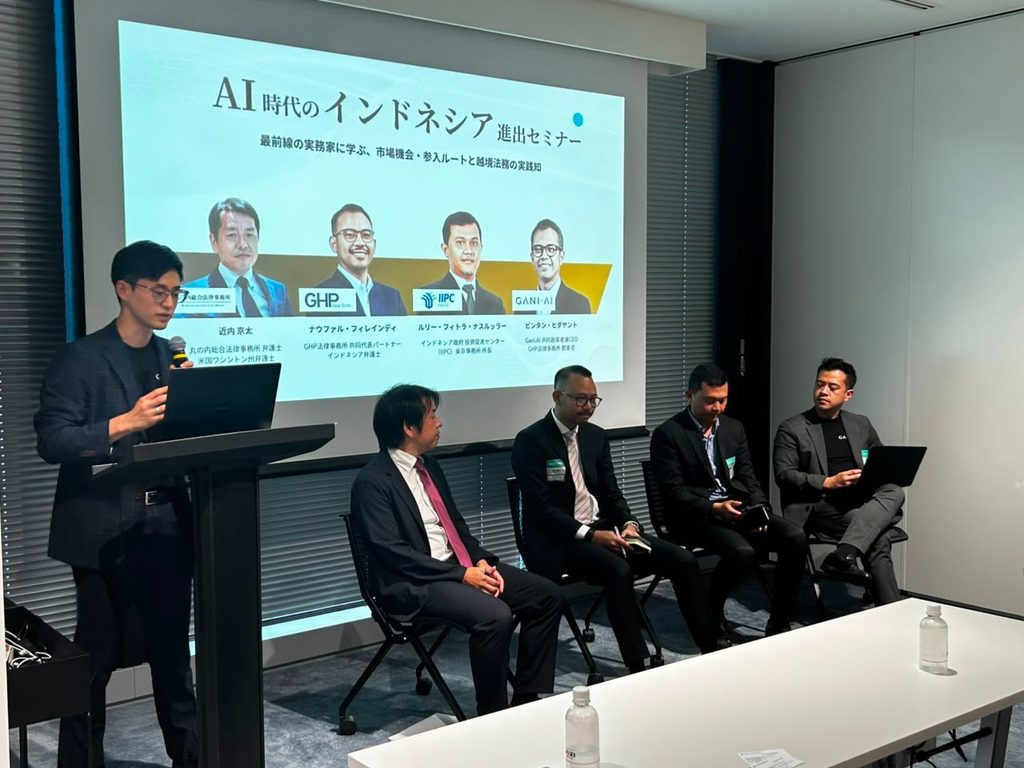
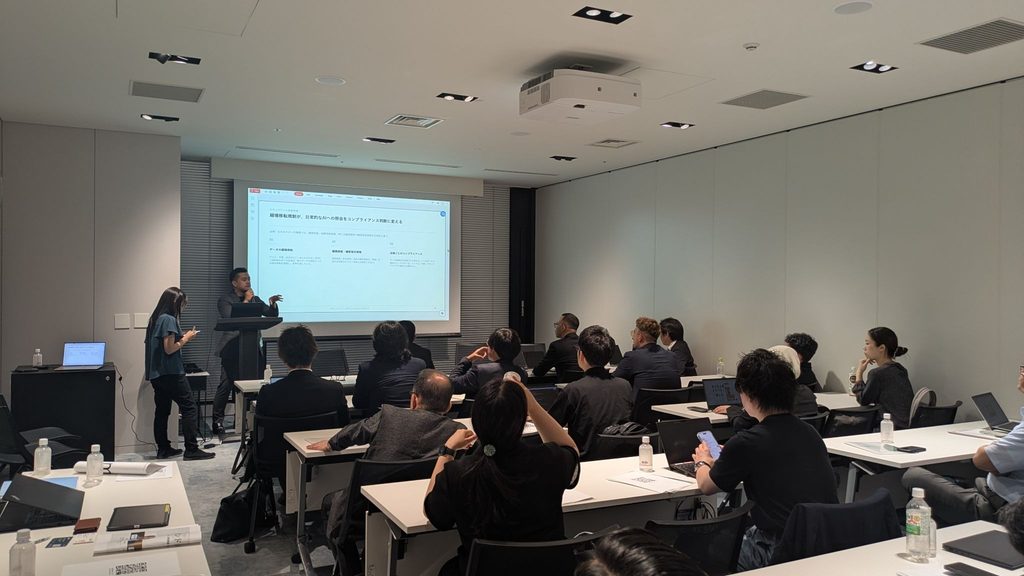
On August 5, 2026, we hosted the seminar “Indonesia Market Entry Strategy in the AI Era: Practical Insights on Market Opportunities, Entry Routes, and Cross-Border Legal Operations” at Shibuya Scramble Square in Tokyo.
The event was jointly organized by GHP Law Firm, Gani.AI, and Marunouchi Sogo Law Office, with special support from the Indonesia Investment Promotion Center (IIPC) Tokyo Office and support from W Fund.
The seminar brought together experts working at the forefront of investment promotion, Indonesian and Japanese legal practice, and AI technology.
Rather than focusing only on the question of “Why Indonesia?”, the discussion explored the practical decisions Japanese companies face when entering the market: how to choose between exports, distributors, joint ventures, and local incorporation; how to design governance between headquarters and local operations; and how AI can support increasingly complex cross-border legal and regulatory work.
This article highlights some of the key insights discussed during the event.
From “Should We Enter Indonesia?” to “How Should We Enter?”
Indonesia is home to the largest population in Southeast Asia and represents one of the region’s most significant consumer markets.
For Japanese companies, Indonesia has long been an important base for industries such as automotive manufacturing and electronics. At the same time, new opportunities are emerging across a broader range of sectors, including food and beverage, healthcare, digital services, payments, and data infrastructure.
However, market growth alone is not enough to justify an investment decision.
One of the recurring themes throughout the seminar was that the key question is no longer simply:
“Should we enter Indonesia?”
Instead, companies increasingly need to ask:
Which market opportunities should we pursue?
Should we begin with exports, a local partner, a joint venture, or a local entity?
How should decision-making authority be divided between headquarters and the local operation?
And how should technology support the growing volume and complexity of cross-border work?
Successful market entry requires these questions to be considered together as part of a coherent market-entry strategy.
The discussion can be summarized around four key themes:
- Business opportunities in Indonesia are expanding beyond traditional manufacturing
- Market entry does not always need to begin with local incorporation
- Governance between headquarters and local operations is critical to long-term success
- In high-risk professional workflows, the way AI is governed matters as much as the technology itself
1. Where Are the Opportunities for Japanese Companies in Indonesia?
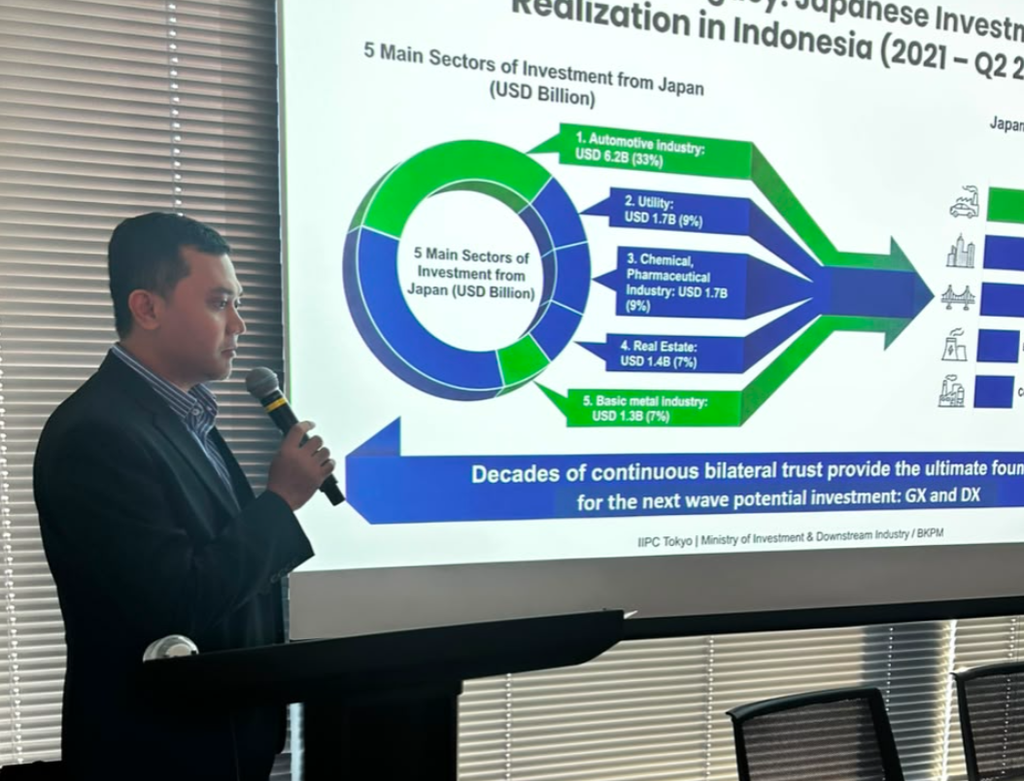
The first session featured Ruly Fitra Nasrullah, Director of the Indonesia Investment Promotion Center (IIPC) Tokyo Office, who discussed the current state of Japanese investment in Indonesia and emerging areas of opportunity.
Indonesia’s young population and expanding middle class continue to support the development of a large and increasingly sophisticated consumer market.
Japanese companies have already established a strong presence in sectors such as automotive manufacturing and electronics. However, significant room for further market development remains in areas including food and beverage, e-commerce, and technology.
The expansion of Indonesia’s digital economy is another important trend.
Demand continues to grow for infrastructure supporting digital services, including payment infrastructure and data centers. These opportunities are also beginning to extend beyond Jakarta and Java into other parts of the country.
Changes in mobility and industrial policy, including the development of the electric vehicle ecosystem, were also discussed as examples of how government policy can create new areas of commercial opportunity.
The key lesson is that companies should not make investment decisions solely on the basis of macroeconomic indicators such as population size or GDP growth.
Instead, they need to determine where their own products or services fit within the market.
Who is the target customer?
Which regions should be prioritized?
What does the competitive landscape look like?
And what regulatory constraints may affect the business model?
The first step is therefore to translate Indonesia’s overall market potential into a specific and realistic opportunity for the individual company.
2. Market Entry Does Not Have to Begin with Establishing a Local Entity
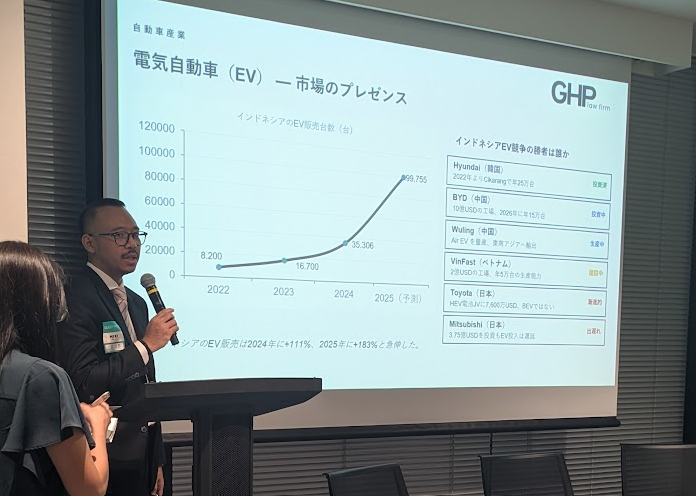
The second session, led primarily by Naufal Fileindi, Co-Managing Partner of GHP Law Firm, focused on practical market-entry structures and regulatory considerations.
When companies think about overseas expansion, establishing a local subsidiary is often one of the first options that comes to mind.
In practice, however, companies may enter Indonesia through a range of structures, including exports, local distributors, licensing arrangements, joint ventures, and the establishment of a foreign-owned company, or PT PMA.
There is no single correct model.
The appropriate structure depends on the nature of the business and the company’s stage of market development.
For manufacturers, for example, one approach discussed during the seminar was to begin by exporting products into Indonesia before making a major investment in local production.
This allows a company to test:
- whether genuine market demand exists;
- whether the market will accept the intended pricing;
- whether logistics and distribution are workable; and
- what type of local sales channel will ultimately be required.
This is not simply about minimizing initial investment.
It is about avoiding large and difficult-to-reverse commitments before the company has accumulated enough market knowledge.
Companies can instead use real market feedback to inform each subsequent investment decision.
Where a local company is established, businesses must also understand the applicable Indonesian business classification, or KBLI, together with foreign investment rules, licensing requirements, investment requirements, and any relevant distribution restrictions.
The important question is therefore not simply whether a company can legally establish an entity in Indonesia.
It is whether the entity can actually operate the business model the company intends to pursue.
The same principle applies when working with local partners.
A company should not select a distributor or business partner solely because it has an existing sales network.
Financial strength, regulatory capability, industry relationships, reputation, and compliance systems all need to be considered when assessing whether a partner is suitable for a long-term relationship.
Market-entry strategy and legal structuring should therefore not be treated as separate exercises.
Designing an entry structure that can actually support the intended business model is itself a fundamental part of market-entry strategy.
3. After Establishing a Local Entity, How Should Headquarters Stay Involved?
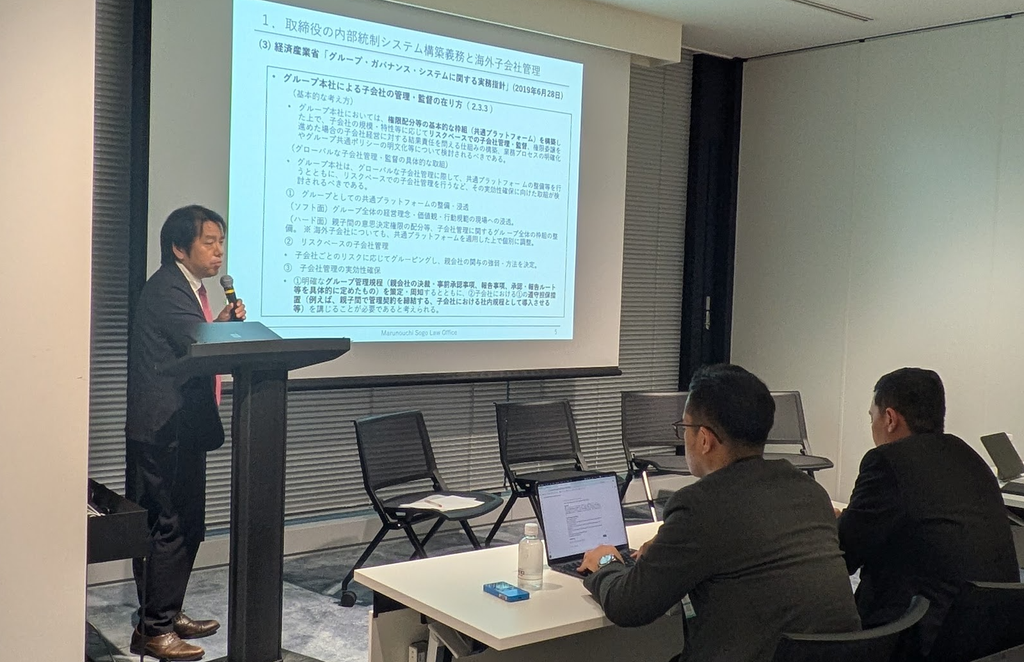
Kyota Konnai, Attorney at Marunouchi Sogo Law Office, addressed the question of overseas subsidiary and joint-venture governance from the perspective of a Japanese headquarters.
Companies often devote significant attention to market entry and incorporation.
Once the business begins operating, however, a different set of questions quickly emerges:
How much authority should local management have?
Which decisions require approval from headquarters?
How does headquarters obtain visibility when an issue arises?
At the center of these questions is the design of decision-making authority.
If every decision requires approval from Japan, local operations can become slow and ineffective.
If too much authority is delegated, however, legal and compliance risks may develop without sufficient visibility at headquarters.
For this reason, approval requirements should not be determined solely by transaction size or financial value.
They should also reflect the nature of the underlying risk.
Routine commercial activities may be delegated to the local organization, while certain activities involving public officials, donations, or other areas with heightened anti-bribery risk may require prior headquarters approval regardless of financial value.
The session also highlighted the importance of using multiple governance mechanisms together, including group-company management policies, management arrangements with local subsidiaries, board appointments, shareholder rights, and audit processes.
Cross-border operations involve overlapping risks across employment, contracts, data protection, anti-bribery, and third-party management.
Rather than escalating every problem to headquarters on an ad hoc basis, companies should establish in advance:
Who has authority to make the decision?
At what point must the matter be escalated?
And:
Which decisions require headquarters approval?
A sustainable governance model therefore depends on defining decision rights and escalation mechanisms before problems occur.
4. Cross-Border Legal Work in the AI Era: The Question Is Not Whether to Use AI, but How to Use It
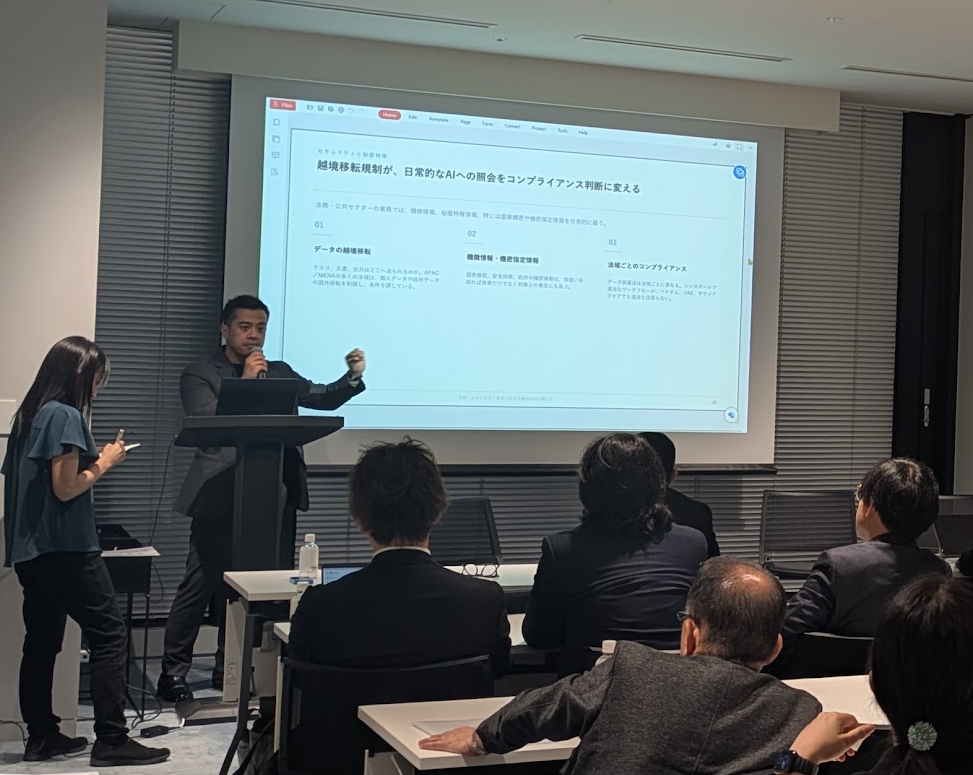
The final deep-dive session was led by Bintang Hidayanto, Co-Founder and CEO of Gani.AI, who discussed the use of AI in legal and regulatory workflows based on his experience in both legal practice and AI product development.
AI is creating significant opportunities to improve the efficiency of cross-border work.
Legal research, contract review and drafting, multilingual document processing, communication with local counsel, and internal knowledge retrieval are among the areas where AI can reduce the amount of time traditionally required from professionals.
However, in legal and compliance work, where the cost of error can be significant, simply “adopting AI” is not the objective.
The session highlighted four principles in particular.
| Competent Oversight | Organizations need people who are capable of reviewing and validating AI-generated outputs appropriately. |
| Non-delegable Judgment | Final professional judgment and responsibility should not be delegated to AI. |
| Source Traceability | Information provided by AI should be traceable back to the underlying laws, regulations, documents, and other authoritative sources. |
| Quality Control Trail | Organizations should be able to record who used an AI-generated output, how it was used, and where it was incorporated into a document, workflow, or decision. |
These principles go beyond simply creating an internal “AI usage policy.”
If AI is to become deeply integrated into organizational workflows, companies need to consider the entire operating model, including data governance, access controls, review processes, auditability, and accountability.
Organizations handling confidential or personal information also need to understand how their AI providers manage data retention, model training, external API transmission, and access permissions.
There are longer-term operational risks as well.
When business-critical processes become heavily dependent on a third-party AI service, future changes to that service, vendor continuity, and the difficulty of migrating to another system can all become material risks.
The objective is therefore not necessarily to build every AI capability internally from scratch.
Instead, organizations should seek an architecture in which they maintain appropriate control over their data, knowledge, governance, and workflows.
Depending on the level of risk and the nature of the task, this may involve the use of general-purpose AI, specialized professional AI, or a dedicated enterprise environment.
Selecting the appropriate architecture for each type of work is becoming an increasingly important part of enterprise AI strategy.
Q&A: Moving from General Principles to Practical Market-Entry Questions
Each session was followed by an anonymous Q&A, allowing participants to raise specific questions related to their own business activities.
Topics included AI regulation in Indonesia, investment structures for manufacturers, the selection of local partners, distribution models, and corporate governance.
For manufacturing companies, the discussion again emphasized the value of a staged approach: testing demand and logistics through exports before committing to large-scale local production.
AI and data regulation in Indonesia were also discussed, with speakers emphasizing the importance of monitoring not only formal regulatory developments but also how rules are interpreted and enforced in practice.
Following the seminar, participants and speakers continued discussions during a networking and individual consultation session, allowing for more detailed conversations around specific business situations.
Market Strategy, Legal Structuring, Governance, and Technology Must Be Designed Together
One of the clearest conclusions from the seminar was that there is no universal formula for entering Indonesia.
Entering because the market is large is not enough.
Avoiding the market because regulation is complex is not enough.
Establishing a local entity does not, by itself, constitute a successful market-entry strategy.
And introducing AI does not automatically make cross-border operations more efficient.
Companies first need to define which opportunity they are pursuing and how much investment risk they are prepared to take.
They then need to select an entry structure that reflects those objectives.
Once operating locally, they need to establish a governance model that appropriately allocates authority between headquarters and the local business, supported by effective legal, compliance, and data controls.
Finally, as cross-border work becomes more complex, organizations need to combine professional expertise with AI in a way that turns fragmented work into repeatable and governable processes.
Market strategy, legal structuring, governance, and technology should not be treated as separate topics. They need to be designed as one integrated operating model for international business.
This is becoming increasingly important as Japanese companies consider how to build sustainable operations in Indonesia and across other international markets.
Gani.AI will continue to work with GHP Law Firm and other professional partners across jurisdictions to help organizations manage complex cross-border legal and regulatory work more safely and efficiently.
For companies interested in cross-border legal and regulatory research, contracting workflows, enterprise knowledge management, or AI-enabled professional workflows, please contact us through the Gani.AI website.
Event Overview
Event
Indonesia Market Entry Strategy in the AI Era: Practical Insights on Market Opportunities, Entry Routes, and Cross-Border Legal Operations
Date & Time
August 5, 2026
6:00 PM–8:20 PM
Venue
Seminar Room, MIXI Office
Shibuya Scramble Square, Tokyo
Format
Invitation / registration approval required
Organizers
GHP Law Firm
Gani.AI
Marunouchi Sogo Law Office
Special Support
Indonesia Investment Promotion Center (IIPC) Tokyo Office
Supported by
W Fund, in collaboration with MIXI
Speakers
Ruly Fitra Nasrullah
Director, Indonesia Investment Promotion Center (IIPC) Tokyo Office
Naufal Fileindi
Co-Managing Partner, GHP Law Firm
Indonesian Advocate
Bintang Hidayanto
Co-Founder & CEO, Gani.AI
Founder, GHP Law Firm
Kyota Konnai
Attorney, Marunouchi Sogo Law Office
Attorney at Law, State of Washington, USA
This article has been edited and summarized based on presentations and discussions held during the event. The application of laws and regulations may vary depending on the relevant business, jurisdiction, timing, and specific circumstances. Nothing in this article is intended to constitute legal advice in relation to any particular matter.